
By Tom Goskar, August 2026
The most famous beasts of Cornish folk customs are the Padstow ’Obby ’Osses: the Old ’Oss and the Blue Ribbon ’Oss. But there is a newer beast on the block that is dominating folky social media circles and creeping into books. I am talking about the skull-and-pole ’osses, or “guise beasts” as many now call them.
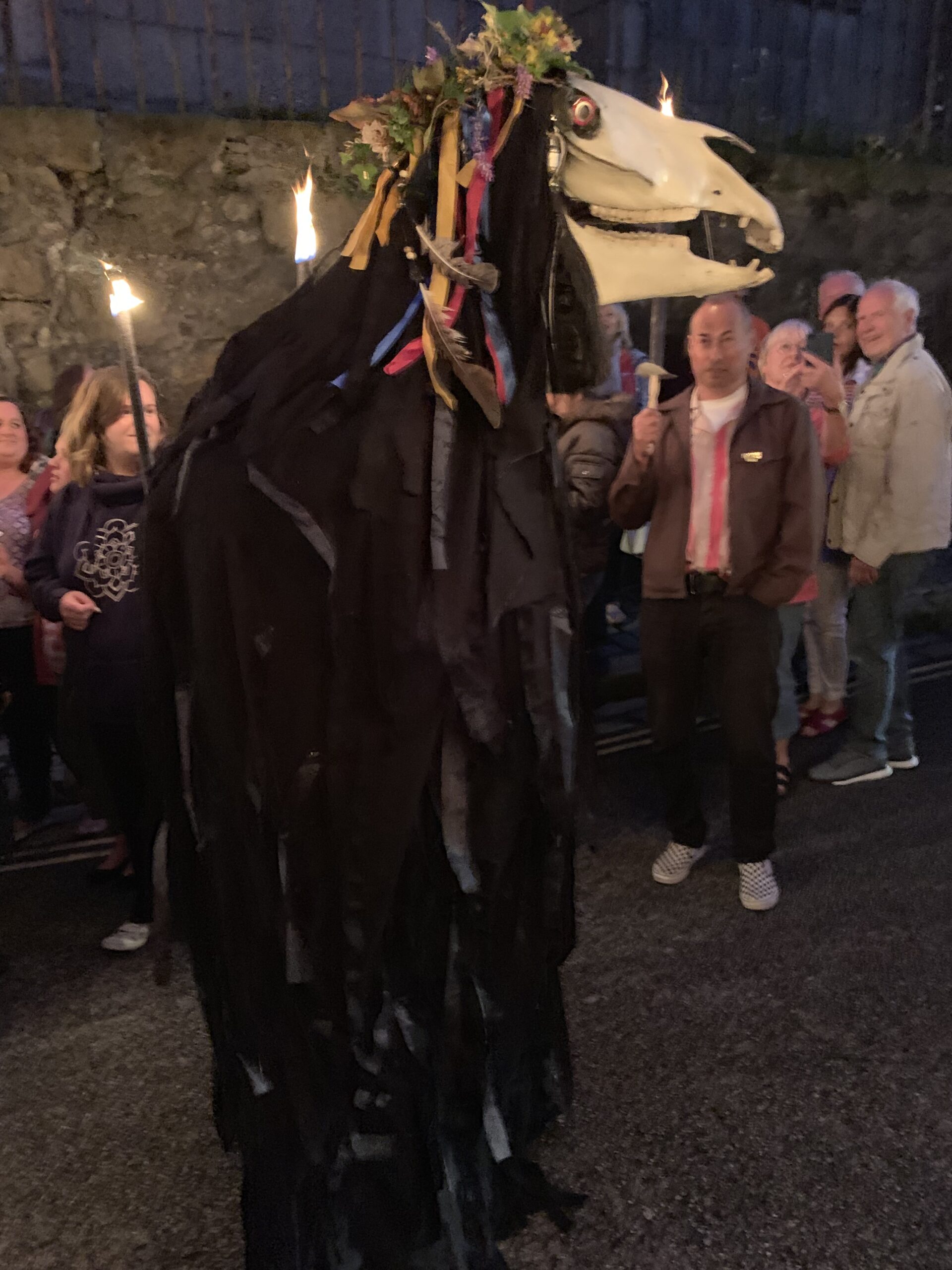
They are tall characters, usually consisting of a horse skull on a pole, with a long cowl concealing the ‘rider’. They often have an articulated jaw which can snap and grin at audiences, and they are often led by a teaser who dances with the ’oss and encourages it as it capers about. The teaser also performs an important practical role in helping the rider know where to walk or run. It is not easy to see through a small netting or lace-covered slot in a cape.
Many people believe that the skull-on-a-pole type of ’oss was once widespread across Cornwall. Today they are mainly concentrated in the far west, around Penzance, and are associated with the Raffidy Dumitz Band, Golowan, and Montol, the town’s festival of Cornish midwinter customs held around the Winter Solstice. They are increasingly found further across Cornwall. Boney ’osses are also seen in Falmouth, probably further afield, and many gather together at gatherings like Tintagel’s Dark Gathering billed as the “Celebrating the annual meeting of the Cornish ‘Osses with the Welsh Mari Lywds”.
But what does the evidence say? Historiography has an important role to play here.
It is worth distinguishing between three different things: what nineteenth-century sources actually describe; what twentieth-century folklorists and Cornish revivalists inferred from those descriptions; and what modern performers have creatively built from those interpretations. These are not the same thing. A modern tradition can be meaningful, powerful, and authentically Cornish without necessarily being an ancient survival.
Dr Merv Davey, in his recent blog post “Milva Kernow: A Cornish Bestiary”, which was presented as a paper at a pagan conference in 2024, opens by explaining that in 1979 the Cornish dance group Cam Kernewek created their own skull-on-a-pole beast, Pen Gwyn, to take to the Pan Celtic Festival in Killarney, south west Ireland, that year1. They were inspired by a reference that Robert Morton Nance, a major figure in the Celtic Cornish movement and a founder of the Old Cornwall/Kernow Goth movement in the 1920s, made in his pamphlet “Folk-Lore Recorded in the Cornish Language”. It sounded like Cornwall had its own equivalent to the Welsh Mari Lwyd. And why not? Historically there has been a lot of contact with Wales, and the Welsh and Cornish languages are deeply related.
Nance’s wording is important, because it appears to be the moment at which Penglaze becomes a horse-skull hobby horse. He wrote:
The Cornish name, “Penglaze,“ of a representative in West Cornwall of the Welsh Mari Llywd, a horse-skull hobby-horse, with its meaning “grey head“ – pen glâs, so like that of the Welsh name, shows that this feature of Christmas guise-dancing was Celtic also2.
This is a striking sentence, but it is not a description of something Nance had seen, nor does it quote an earlier source for a Cornish horse skull. Rather, it seems to be an interpretation built from the name Penglaze and its apparent similarity to the Welsh Mari Lwyd. The argument depends heavily on the meaning “grey head”.
But “grey head” does not necessarily mean “horse skull”. It could also be a reference to an old man with grey hair. Nance’s own pamphlet shows that colour-and-head or colour-and-hair names could be applied to human figures. On page 12 he gives Pedn Gwidn, “white head”, and John Erguden, from ergh-guden, “snow lock”, from the Cornish text of the Life of Meriasek3. These examples show that “grey head” need not imply a skull. It could just as plausibly be a nickname for an old male character, such as the original Penglaz.
This matters because, in William Sandys’ 1833 book Christmas Carols, Ancient and Modern, his description of the guise dance game “The Corn-market” makes it clear that Old Penglaze is not the horse at all. Penglaze is a human character, an old man with a blackened face and a staff, who rides on a comic horse made by another performer girded in a horse’s hide or something resembling one.
Sandys wrote:
Another amusement is called “The Corn-market,” where also there is a master, who has an assistant called Spy-the-market; another essential character is old Penglaze, who has a blackened face, and a staff in his hand, and a person is girded round with a horse’s hide, or what is supposed to be such, to serve as his horse; they are placed towards the back of the market. The other players have each some even price appropriated to them for names, as Twopence, Sixpence, Twelvepence, &c. The master then calls “Spy-the-market,” to which the man replies, “Spy-the-market.” The master again calls “Spy-the-market,” who replies, “Ay, sirrah.” The master then asks the price of corn, the man names some price that is borne by one of the players, as for instance “Twopence.” The master then holds the same conversation with Twopence as he had with his man, and so on till some mistake is made, by any of the party not answering to his name, when the unlucky offender is to be sealed, which constitutes the principal amusement of the game. The master goes up to the delinquent, and taking up his foot says, “Here is my seal, where is old Penglaze’s seal?” and gives him a blow on the foot. Old Penglaze then comes in on his horse, which winces and capers about grotesquely. He is then told that a fine colt wants shoeing, for which he says his reward is a full gallon of moonlight, besides all other customs for shoeing in that market. The shoe of the colt is taken off, and Penglaze gives him one or two hard blows on the sole of the foot, after which he rides off again, his horse capering more than before and sometimes throwing the old gentleman off4.
This passage is important because Sandys does not describe Penglaze as a horse skull, or indeed mention a skull at all. Instead, he clearly distinguishes between Old Penglaze, the man, and the separate performer who serves as his horse.
Folklorist Barbara Spooner (1893-1983), in her 1958 article “The Padstow Obby Oss” in the journal Folklore, reinforced the skull-horse idea:
The hobby-horse that went with the Land’s End Christmas mummers not so long ago was the sort that consists of a horse’s skull held up on a stick by a hide covered or sheet-draped man, and had its own name, in the Cornish Language, that is, Pen-glas, “Grey-head”5.
The footnote for this quote referenced “R. Edmonds, The Land’s End District” as the source of this information. However, upon following this reference to its source, Edmonds does not refer to the name “Pen-glas”, nor does he describe a skull-based hobby horse. Spooner appears to have become a little lost in her references.
In 1846, Richard Edmonds gave a paper to the Penzance Natural History and Antiquarian Society entitled “On some Ancient Customs in the western extremity of Cornwall”. He published his paper in volume one of the society’s transactions in 1851, and reprinted parts of it in his 1862 book The Land’s End District6.
The 1846 paper, published in 1851, reads:
Our Christmas plays, also, are very similar to those of the Saturnalia. The guise-dancers (the same as the guisards of Scotland) may be always seen in the streets of Penzance in the evenings from Christmas-day to “twelfth day,” going to or from the houses wherein they are permitted to perform, attired in fantastic dresses and variously disguised. A well-known character amongst them, about forty years ago, was the hobby-horse, represented by a man carrying a piece of wood in the form of a horse’s head and neck, with some contrivance for opening and shutting the mouth with a loud snapping noise, the performer being so covered with a horse cloth or hide of a horse, as to resemble the animal, whose curvettings, biting, and other motions, he imitated. Some of these “guise-dancers” occasionally masked themselves with the head, horns, and skins of bullocks, a practice not yet entirely discontinued7.
In his Land’s End book, published in 1862, Edmonds slightly amended the description to reflect the passage of time, noting that the hobby horse had been a well-known character “about fifty years ago”. This would place it around 1812, reinforcing the early nineteenth-century context for Penglaze and the guise-dance tradition8.
It is also worth noting how closely Edmonds’ account aligns in tone and detail with Sandys’ earlier description of guise dancing. Both describe a horse figure animated by a concealed performer, capering and behaving in a lively, comic manner as part of Christmas festivities. While Edmonds adds the specific detail of a wooden head and snapping jaws, it is possible that he was at least partly inspired by, or drawing upon, the same tradition recorded by Sandys, if not Sandys’ text itself. This raises the possibility that Edmonds’ account is not entirely independent, but part of a developing nineteenth-century description of the same or closely related customs.
Edmonds does not make any reference to a horse skull on a pole, or to the name “Penglaze” or its various subsequent spellings. He describes a wooden horse’s head and neck, with a snapping mouth. This is very useful evidence for a Cornish hobby horse, and specifically for a West Penwith Christmas guise-dance hobby horse, but it is not evidence for a horse skull.
This is where a small interpretative shift seems to have had large consequences. Sandys gives us Old Penglaze and his horse. Edmonds gives us a snapping wooden-headed hobby horse. Nance, reading the evidence through the suggestive parallel of the Welsh Mari Lwyd, seems to have turned Penglaze into a Cornish horse-skull hobby horse. Later writers then repeated this as though it were already present in the nineteenth-century sources.
It appears that a mistake was made, perhaps originally by Robert Morton Nance, which was then propagated throughout the twentieth century right up to the present day. Many other important articles on hobby horses quoted Barbara Spooner, amplifying the confusion. Violet Alford’s posthumously published The Hobby Horses of Great Britain and Ireland (1978, an expansion of her 1939 Journal of the English Folk Dance and Song Society article Some Hobby Horses of Great Britain) confidently stated:
Our own hobbies may well have pride of place, so many and so varied are they; there are more – I use the present tense which must include those now obsolete – of the skull-and-pole type than of the tourney type, while a few conform to no type at all but have evolved their own shape and manner. The most famous of these live in the West Country, so we follow them from a poorly described specimen in the Land’s End district to where they can look across at the Welsh mare on the far side of the Severn Sea. The Land’s End animal had a head and neck and snapping jaws. In 1862 his carrier was covered by a real horse hide, or failing that a blanket. He went out with Cornish guisers during the Twelve Days. The guisers sometimes wore bullocks’ hides with the horns left on, sometimes the “mummers’ play” was acted, which probably means a version of the St George play. There was also the horse which carried off the body of the slain man and even had lines to say while doing so:
Ashes to ashes, dust to dust,
If Uncle Tom Pearce won’t have him
Aunt Molly must9.
It would appear that Alford’s evidence that the Land’s End horse was “of the skull-and-pole type” is also mistakenly from Edmonds. But again, it seems unlikely that she, or Barbara Spooner, ever read the original, or perhaps Alford (1881-1972) copied Spooner (they were contemporaries), who copied Morton Nance, who misremembered a quote from Edmonds and a name from Sandys. Alford’s reference to the St George, or Mummer’s, Play comes from a script collected in Cornwall and published in 1827 in an edition of William Hone’s The Every-day and Table Book. The stage directions are “The hobby-horse here capers in, and takes off the body.10” Guise dancers often performed this play during Christmastime, and it was also performed more widely across Cornwall and beyond.
It is also worth being clear about the different types of hobby horse. There are tourney horses, worn around the waist, often giving the impression of a rider mounted on a small horse. There are mast or pole horses, where the head is carried on a stick or pole and the performer is hidden beneath cloth. There are skull horses, where the head is an actual skull. And there are carved wooden-headed horses, which is what Edmonds appears to describe. The question is not whether Cornwall had hobby horses. It clearly did. The question is what kind of hobby horse the evidence actually describes.
So what evidence is there for the Cornish skull-and-pole ’oss?
I have not found any pre-twentieth-century written historical evidence for skull-and-pole ‘osses (hobby horses), in Cornwall. Merv Davey’s “Milva Kernow” article mentions a man named Trev Lawrence, a Penwith folk singer and pub landlord who “recalled stories of more than one Pen Glaze and outings at various times of the year rather than just the Christmas Guize Dancing suggested by Nance”11. However much I want to believe, I am sceptical of this as firm evidence because Edmonds’ and Sandys’ texts suggest that Penglaze was a character from around 1812, and 167 years had passed since 1979.
That does not mean Trev Lawrence’s recollection should be dismissed. Oral history is important, especially in folk tradition, and Lawrence may well have known local stories that had not been written down. But without knowing whether he was recalling first-hand experience, family tradition, local anecdote, or stories already influenced by the Old Cornwall and folk revival movements, it cannot carry the same evidential weight as Sandys or Edmonds. If Old Penglaze and his horse were seen out and about between Edmonds’ time and the 1970s, I can’t help but think that this might have been a revival after the 1920s, perhaps involving the Old Cornwall revival of the Mummer’s Play, which often featured a hobby horse.
Looking at other sources, in July 1595, during the Spanish raids on Mount’s Bay, their commander, Carlos de Amézola, wrote in his log that when sacking and burning the village of Paul, to the south of Penzance, they discovered in the church “a horse carved in wood and greatly embellished, serving as an idol, worshipped by the people”12. This description would have been written to reflect the Cornish in an unfavourable light to Catholic authorities back in Spain. The horse was destroyed when the invader set fire to the church. Perhaps it was a wooden hobby horse kept in the church for the village feast day or other festivities, like the church at Abbots Bromley, Staffordshire, which houses ancient deer antlers for the annual Horn Dance. We shall never know.
But this evidence needs to be handled carefully. The Paul horse is fascinating because it gives us a pre-modern West Penwith wooden horse object, but it does not tell us that it was a guise-dance mummer’s horse, a processional beast, a church pageant object, or anything else, except that it was not a real horse skull.
All that we can confidently say, backed by documentary evidence, is that the ’osses, or hobby horses, of Cornwall, aside from those at Padstow, were generally in West Penwith, and that at least one was made from wood with a snapping jaw. There were also other animal disguises using bullock heads, horns, skins, and cloth coverings, as described by Edmonds. That is rich material in its own right. But it is not the same as evidence for a horse skull on a pole.
The comparison with the Welsh Mari Lwyd is understandable. It is a real and fascinating custom, and it uses a horse skull carried beneath a cloth. It is easy to see why Cornish revivalists, particularly those interested in pan-Celtic links, would find the comparison attractive. There has been long contact between Cornwall and Wales, and the languages are closely related. But a parallel is not evidence of a Cornish practice. Similarity can inspire revival, but it cannot by itself establish descent.
This information about a “horse’s skull held up on a stick” has, in the modern way, gone viral. From Merv Davey’s Bestiary article, to Dark Cornwall, and most importantly, Wikipedia. This information has been inspirational for many people, resulting in the creation of many beasts since Pen Gwyn, who directly inspired the modern Golowan ’oss, Penglaz, after Pen Gwyn’s appearance at the first revived Golowan festival in 199113.
Penglaz is perhaps the best-known example of how a modern ’oss can acquire real power and mystery. At Golowan, Penglaz first appears at dusk during the St John’s Eve torchlit procession. There is a huge element of excitement when he first charges through the Golowan Band and the crowds of torch bearers. There is mystery, danger, and thrill. Penglaz dances with the teaser and the band, accompanying them towards the quay before disappearing into the shadows. Gone.
He reappears after the Mazey Eve fireworks, at about 11pm, when the mace-bearer of the Golowan Band bangs on the door of Penglaz’s ‘stable’ to summon him to lead the serpent dances (originally known as thread-the-needle) to huge roars of approval from the crowds until he disappears again shortly after midnight. He reappears briefly on the afternoon of Mazey Day, interrupting and then leading more serpent dancing, before disappearing until the following year. The mystery is preserved, along with the anticipation of having to wait for the next Golowan to see him again.
This is important. Part of the power of Penglaz is not just what he looks like, but when he appears, how he appears, and how quickly he is gone. His scarcity gives him force. He belongs to a particular place, a particular festival, and a particular moment in the calendar.
The waiting matters.
Since 1991, many other ’osses have been created. As of 2026 there must be ten or more skull-and-pole beasts appearing in Cornwall, and perhaps beyond, throughout the year. Many have been made with love, skill, and good faith. Some lead bands, some appear in festivals, and some seem to have been created simply because people enjoy them. There is nothing wrong with that in itself. Folk culture is creative, always has been, and must remain so to thrive.
But there is a danger here too. If every band, town, procession, or event has its own boney ’oss, the figure can start to lose some of its mystery. What was once strange, seasonal, and unsettling can become familiar and expected. The skull ’oss risks becoming a generic symbol of Cornish folkiness, rather than a being rooted in a particular custom, place, or season. Instead of making the folk scene richer, too many similar beasts may begin to make it more homogeneous, or become seen to be parodies of themselves.
This is not an attack on those who have made them. Most people who create these beasts do so because they believe they are taking part in something genuinely Cornish and very old. I understand the appeal. I feel it too. A horse skull under cloth, snapping its jaw in torchlight, is a powerful image. I have played music in some of the bands that lead them. But if the historical evidence is much thinner than many people realise, then perhaps we need to be more thoughtful about how often the image is used, and what claims are made for it.
I want to be clear that this does not make the modern skull ’oss fake, meaningless, or illegitimate. Merv Davey’s work has been central to the modern Cornish dance and music revival, and his Milva Kernow article is incredibly valuable as an account of how these beasts have acquired meaning within contemporary Cornish cultural practice, not to mention informing my own knowledge and sparking many of my own interests. My disagreement is narrower. I do not think the historical evidence supports the specific claim that the skull-and-pole hobby horse was an old, documented Cornish form. The modern beast may be authentically Cornish as a revival creation, but that is different from being demonstrably ancient.
Pen Gwyn, Penglaz, and the other contemporary beasts are now part of Cornish folk culture. They have acquired their own history, symbolism, makers, performers, songs, stories, and audiences. They are authentically Cornish because Cornish people have made them so. Their histories are fascinating, full of creativity and rivalry. Maybe someone will be brave enough to write about it one day.

But that is not the same as saying that they are ancient survivals. The skull-and-pole ’oss is best understood as a modern Cornish creation, shaped by a mixture of nineteenth-century guise-dance evidence, twentieth-century Celtic interpretation, Welsh Mari Lwyd imagery, and the creativity of late twentieth-century Cornish performers. That story is interesting enough on its own. It does not need to be made older than the evidence allows.
Perhaps the next stage is not to make more and more skull ’osses, but to think more carefully about what each one is for. What place does it belong to? What season does it mark? What story does it tell? What does it do that another ’oss does not already do?
If these beasts are to remain powerful, they need more than skulls, cloaks, and snapping jaws. They need meaning, restraint, and mystery.
It's impossible in the course of any research to uncover absolutely everything, so there may well be a source with evidence of historical skull 'osses that I have entirely missed (but I have looked very hard and for many years!). If there's a definitive reference that you think I should know about, please contact me.
References
- Merv Davey, “Milva Kernow: A Cornish Bestiary”, Cornish National Music Archive, 2024, https://cornishnationalmusicarchive.co.uk/content/milva-kernow-a-cornish-bestiary/. Davey describes Pen Gwyn as having been created by Cam Kernewek in 1979 for the Pan Celtic Festival in Killarney. ↩︎
- Robert Morton Nance, “Folk-Lore Recorded in the Cornish Language”, Camborne: Camborne Printing and Stationery Company Ltd., undated, sold by J. A. D. Bridger, Penzance, p. 4. Nance spells the Welsh form “Mari Llywd” in the quoted passage. The usual modern Welsh spelling is “Mari Lwyd”. ↩︎
- Robert Morton Nance, 1924, “Folk-Lore Recorded in the Cornish Language”, p. 12 ↩︎
- William Sandys, Christmas Carols, Ancient and Modern; Including the Most Popular in the West of England, and the Airs to Which They Are Sung, London: Richard Beckley, 1833, introduction, p. cxiii. ↩︎
- Barbara Spooner, “The Padstow Obby Oss”, Folklore, Vol. 69, No. 1, 1958, pp. 34-38. ↩︎
- Richard Edmonds, “On some Ancient Customs in the western extremity of Cornwall”, Transactions of the Penzance Natural History and Antiquarian Society, Vol. 1, 1851; Richard Edmonds, The Land’s End District: Its Antiquities, Natural History, Natural Phenomena and Scenery, Penzance: F. T. Vibert, 1862. ↩︎
- Edmonds, “On some Ancient Customs in the western extremity of Cornwall”, 1851. ↩︎
- Edmonds, The Land’s End District, 1862, p. 69. ↩︎
- Violet Alford, The Hobby Horses of Great Britain and Ireland, London: Merlin Press, 1978. ↩︎
- William Hone, The Every-day Book and Table Book, Vol. II, London: William Tegg, 1827, pp. 122-126. ↩︎
- Merv Davey, “Milva Kernow: A Cornish Bestiary”, Cornish National Music Archive, 2024, https://cornishnationalmusicarchive.co.uk/content/milva-kernow-a-cornish-bestiary/ ↩︎
- Dan Cruickshank, Invasion: Defending Britain from Attack, London: Boxtree, 2001. The quoted account is attributed to Carlos de Amézola during the Spanish raid on Mount’s Bay in 1595.
↩︎ - Davey, “Milva Kernow: A Cornish Bestiary”. See also modern accounts of the Golowan revival and the development of Penglaz in Penzance. ↩︎


6 Comments
There is the other train of thought about our ‘Penzance ‘osses …..esp at Montol… with world going upside down… that she truly does embellish the ‘true meaning’ of the Night Mare as SHE gallops down Chapel Street on a certain evening in December!
I believe that the ‘oss called Kasek Nos means Night Mare in Kernewek (Kasek = Mare, Nos = Night), and that she was created in the last 12 years or so… (2014ish?)
Kasek Nos was made in 2014 and has since returned to her maker for use in private events. We made Borlowen last year as a replacement, not to add a new oss unnecessarily but we firmly believe osses made for Penzance should stay in Penzance and have made a pact with Montol that this will always be the case with ours.
Thanks Rebecca! I thought she appeared around then. Glad that Borlowen (great name – the Cornish name for Venus) has made that commitment. It would be good to see more guise dancers and their creations out and about until Degol Stul (12th Night) or Plough Monday, as Montol is just the organised part of something much bigger and older that most people have forgotten.
I agree, but it requires people with the time, energy and gumption to do it and Montol is so big these days it draws so much of our time and energy. 3 beasts plus morris dancing and I am broken by the end of it!
I would love to recreate the Paul Oss one day, maybe for such a purpose. Just love the idea of the colourful robe and carved wood head. Time, money, energy and space currently lacking directly after Christmas! Maybe when the children are bigger…
Maybe one day! For us it’s just slinging on our guise dancing costumes and heading out, but then we’re lucky to live where we do. Guise dancing was done across West Penwith, and we have also done it where you guys are between Christmas and New Year…
Regarding the Paul horse, it might have had a colourful robe – all we know is that Carlos de Amézola claimed it was “greatly embellished” and I think your idea would be quite fitting.